Tulips and dot com stocks, what is a Market Bubble?
There have been market bubbles throughout history. Two of the most famous were the Tulip Mania in the Netherlands in the 1630s and the stock market crash in the late 1920s in the United States at the front end of the Great Depression. During the Tulip Mania, investors kept bidding up the price of rare tulips (really futures contracts sold several times over on the same tulip) thinking the tulip could then be resold for ever increasing prices. The price of the tulip contracts became unhinged from the actual worth of the tulip (at one point reaching the price of a house) and when no additional buyers could be found the market for tulips crashed as did the fortunes of those left holding the contracts.
Moving on from tulips, stock prices should be based on the expected future prospects for the earnings of the company whose stock is purchased. There is a lot mixed up in the expected future earnings, none of which is known for certain–the current and future economic environment and the prospects for the company itself in that economic environment.
The stock market became a bubble in 1929 for the same reason as the tulip mania—investors borrowed money to buy stocks not because of the intrinsic worth of the underlying companies but because it seemed like the stock could be resold for ever increasing prices. It was thought to be easy money. Stocks would simply continue to appreciate without stopping regardless of the economic outlook or the future prospects for the company. Additionally, credit was easy, and there were fewer borrowing restrictions on stock investors than there are today. Investors could borrow up to 90% of the value of a stock purchase, making it easier for people from all walks of life to invest. The fear of missing out tends to be an element of a bubble, and that was true in 1929. New investors did not want to miss out on the easy money everyone was talking about. There were many reasons for the market crash, one of which was the Fed increasing interest rates in August 1929, making it more expensive to borrow to buy stocks, causing buyers to become sellers and driving prices down. The Fed’s actions remain an important consideration when we consider the bubble question today.
S&P 500 Index 1927 to 1932
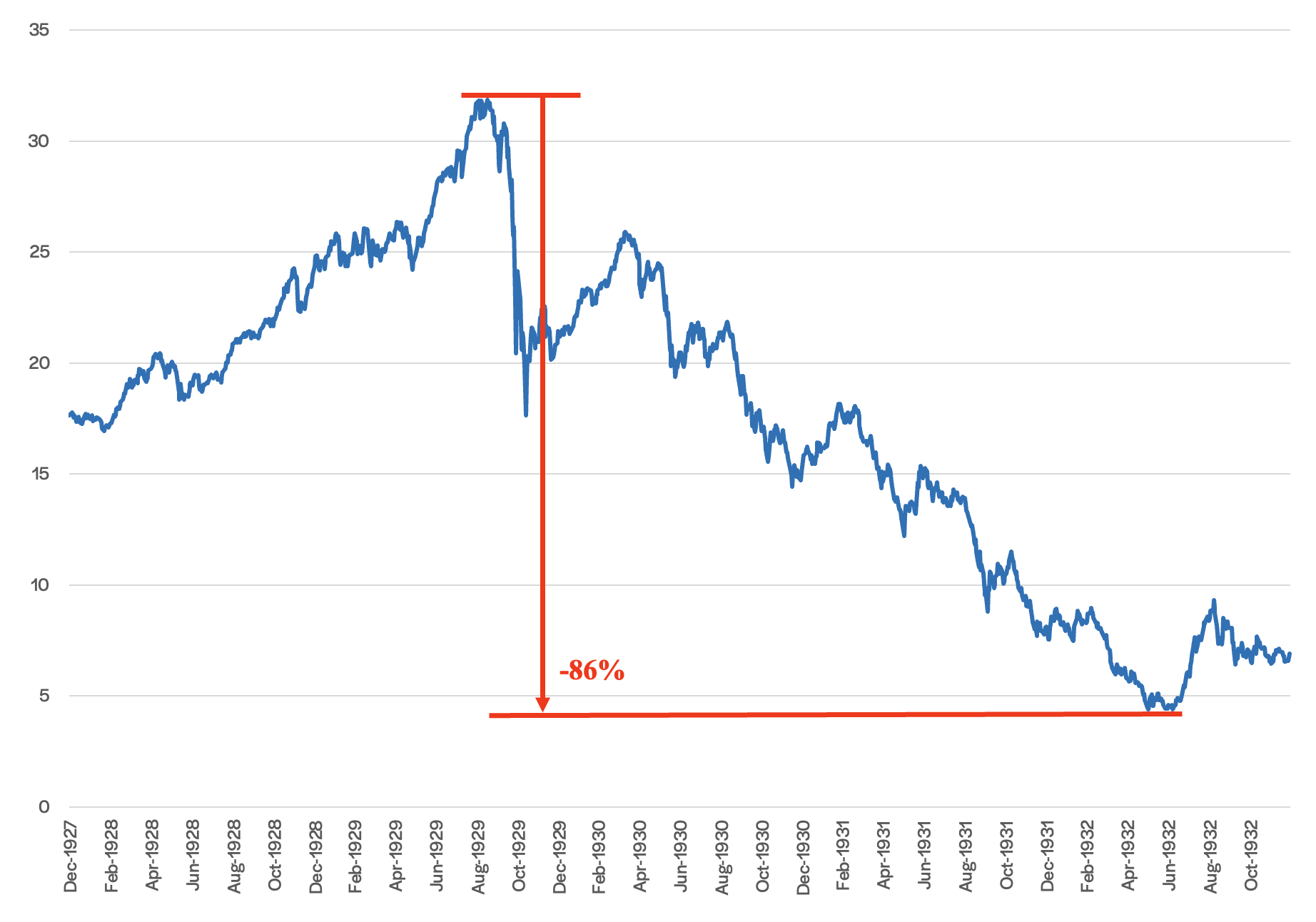
Source: Bloomberg
A stock market correction is defined as the stock market falling by more than 10%. Corrections are not fun, but they happen on average about once a year. Over my 30-year career as a wealth manager, that works out to approximately 30 corrections. The most recent correction occurred earlier in April 2025 when tariffs were made an issue by the administration, and the S&P 500 index briefly touched down 20% off its highs. The changes to the market outlook can move at breakneck speed—the tariff worry becomes more difficult to remember now that the S&P 500 total return has not only recovered but is up 17.88% in 2025. As an investor, it’s important to remember that occasional market corrections are a natural part of the stock market’s long-term upward trend, even though it’s equally natural to worry that a correction could be the start of something worse. Both are important considerations when worrying about bubbles.
While market corrections occur, on average, about once per year, true bubbles are far less common. In my 30 years as a wealth manager, I have experienced only two. The most recent was the Great Financial Crisis in 2008, which, while likely less relevant to today’s AI debate, was the more frightening of the two because it was fundamentally a crisis of the financial system itself. It was clear at the outset that the powers that be were not certain how to respond, and the talk was that a misstep could lead to another depression. The causes of the bubble had similarities to the 1920s but were more concentrated in the real estate sector. Credit was easy and underwriting was lax. Investors piled into the housing sector because banks were willing to lend to investors with poor credit and no money down. Banks offloaded the risk by packaging the mortgages and selling them to other investors, including other banks. Home buyers were willing to take the risk of being way overleveraged with no ability to pay the loans back because they thought they could turn around and sell the homes for a quick profit. Banks sold their mortgage securities, and investors sold their homes beyond values that made sense. This trend persisted even as the Fed raised interest rates from mid-2004 to mid-2006. The proverbial music stopped when low teaser rates on adjustable-rate mortgages began to expire, resetting borrowing costs higher and triggering a surge in defaults. Speculative demand for houses declined, causing prices to fall, and many buyers and investors found themselves owing more on their mortgages than their homes were worth. The aftermath was severe: the stock market fell 37% in 2008 and continued down another 25% in early 2009.
S&P 500 Index 2007 to 2010

Source: Bloomberg
The other major bubble during my investing career was the dot-com craze of the late 1990s. It is particularly relevant to today’s discussion because it is the period most often compared to the current AI-driven environment. At the time, the internet was widely viewed as a society-transforming technology, and that belief fueled a mania in which investors rushed into nearly any company associated with the internet, assuming all would ultimately succeed. Traditional methods for valuing companies were thrown out the window, and companies with no earnings went public to great fanfare and wildly bid up prices. A report from early 2000 by an IPO attorney firm noted a record 490 IPOs, 289 of which were internet companies that averaged 90% appreciation on their first trading day.
Again, credit was easy and investors lost their minds justifying the “this time it is different” mantra, forgetting that not every company was going to win the internet, and simply adding “.com” to your company name didn’t guarantee anything. Technology valuations became extreme. The top seven tech companies in the 1990s had an average valuation of 67x forward earnings. Again, part of the reason the music stopped is that credit became more expensive as the Fed raised rates in the second half of 1999 and the first half of 2000. Once sentiment turned, just about all equities suffered regardless of the company’s connection to the internet. The tech heavy NASDAQ bore the brunt of the decline, falling 78% from its peak and didn’t recover its prior peak until 2015. The S&P was down 49% over roughly the same period and did not recover its prior peak until 2007. Although companies like Google, Microsoft, Amazon, Apple, and Meta ultimately emerged as significant winners, in hindsight, just appending “.com” to your company name was no guarantee of success.
NASDAQ Composite Index 1999 to 2003
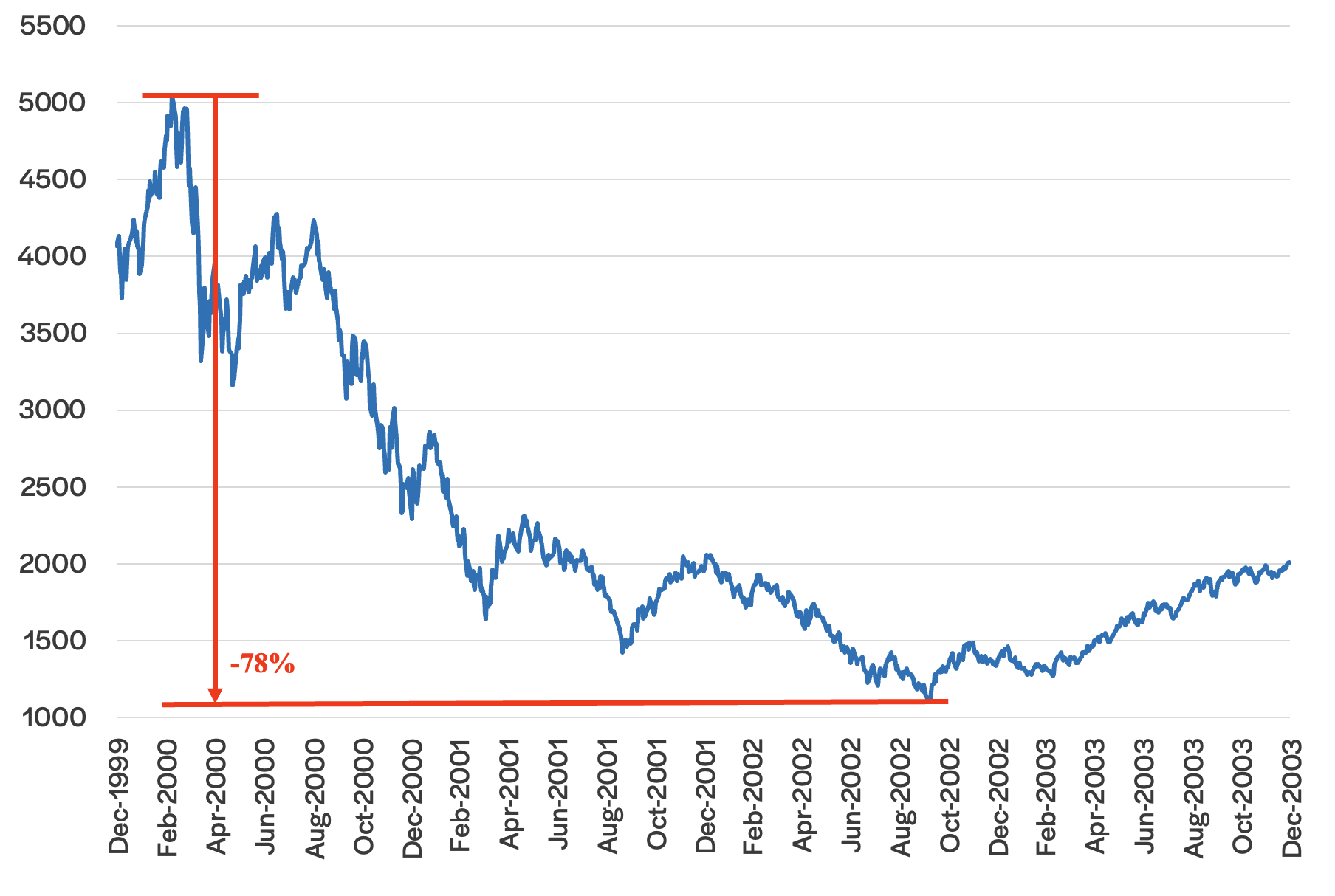
Source: Bloomberg
I think describing the frequency of corrections and the rarity of bubbles is very relevant to setting the stage for an evaluation of the current environment. Certainly, it is important to stay vigilant, as the fear inducing numbers from the dot-com market collapse attest. But simply because the market takes a breather, and the breather turns into a correction, does not necessarily signal impending doom. In fact, it is a harbinger of disaster only in rare instances.
So now we finally get to the question of artificial intelligence, the current environment and evaluating whether or not we are in a bubble. No question, similar to the advent of the internet, AI is transformative technology. In addition to being transformative, the technology requires massive amounts of space in the form of data centers and energy to power the data centers, which are ancillary benefits to certain energy and infrastructure companies.
A direct comparison with the internet bubble will help provide context as we drive toward a conclusion to this article.
Don’t Fight the Fed
While it is important to point out that there are many factors in evaluating the current situation, a particularly useful economic maxim is “Don’t fight the Fed.” When the Fed lowers the Fed Funds rate, it lowers the cost of borrowing and tends to be helpful to the economy and the stock market. While the crazy speculation in almost all internet companies regardless of quality would have likely led to an internet bubble burst in the early 2000s, the fact of the matter is that the Fed was raising rates in late 1999 and early 2000 and most likely helped accelerate the break.
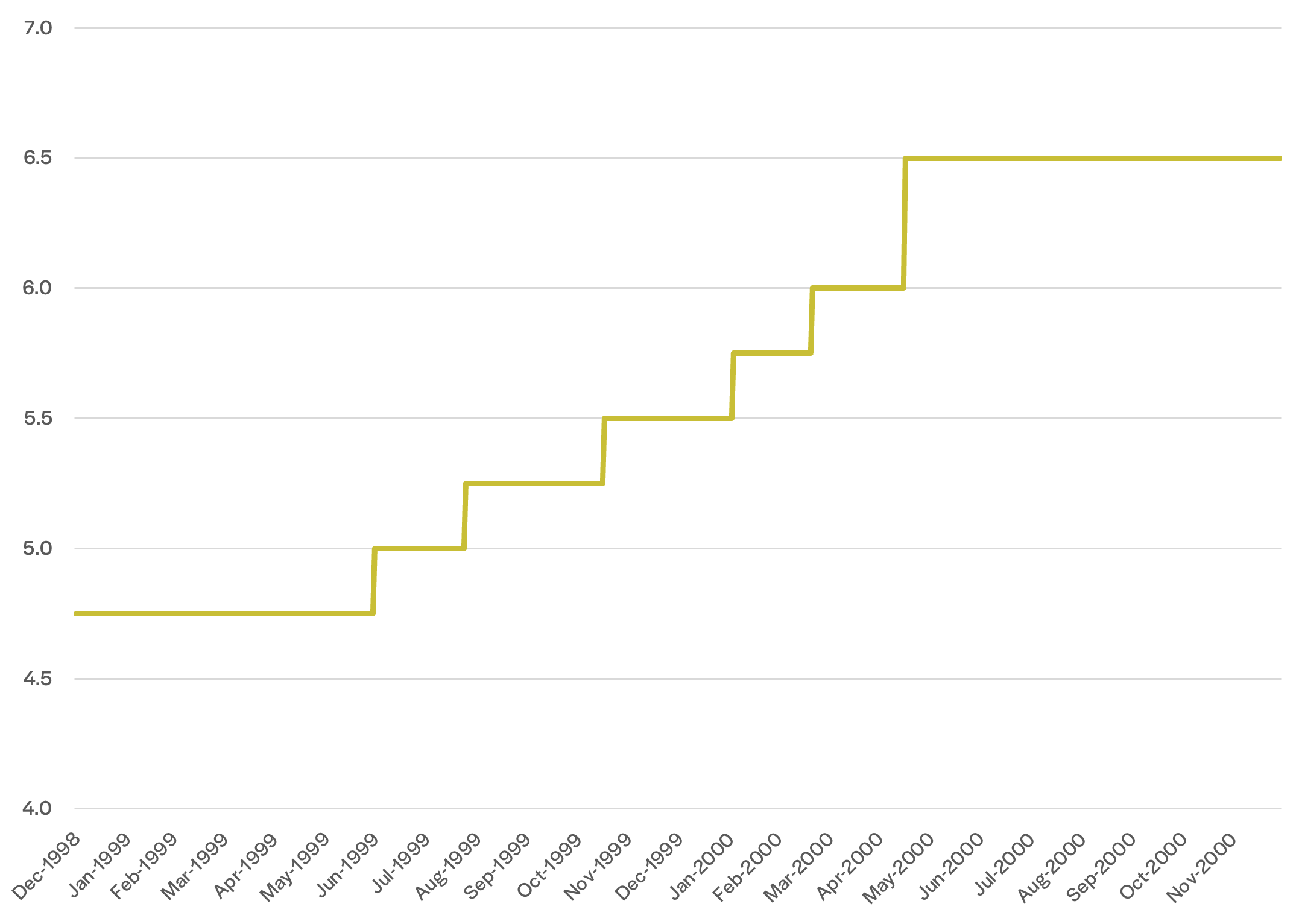
Source: Bloomberg
In contrast, the Fed cut rates three times in 2025 and expects to cut at least once more in 2026. The Fed has communicated that the worry over rising unemployment outweighs inflation concerns. The monetary policy environment is very different in 2025 than in 1999.
Federal Funds Rate 2024 to 2025
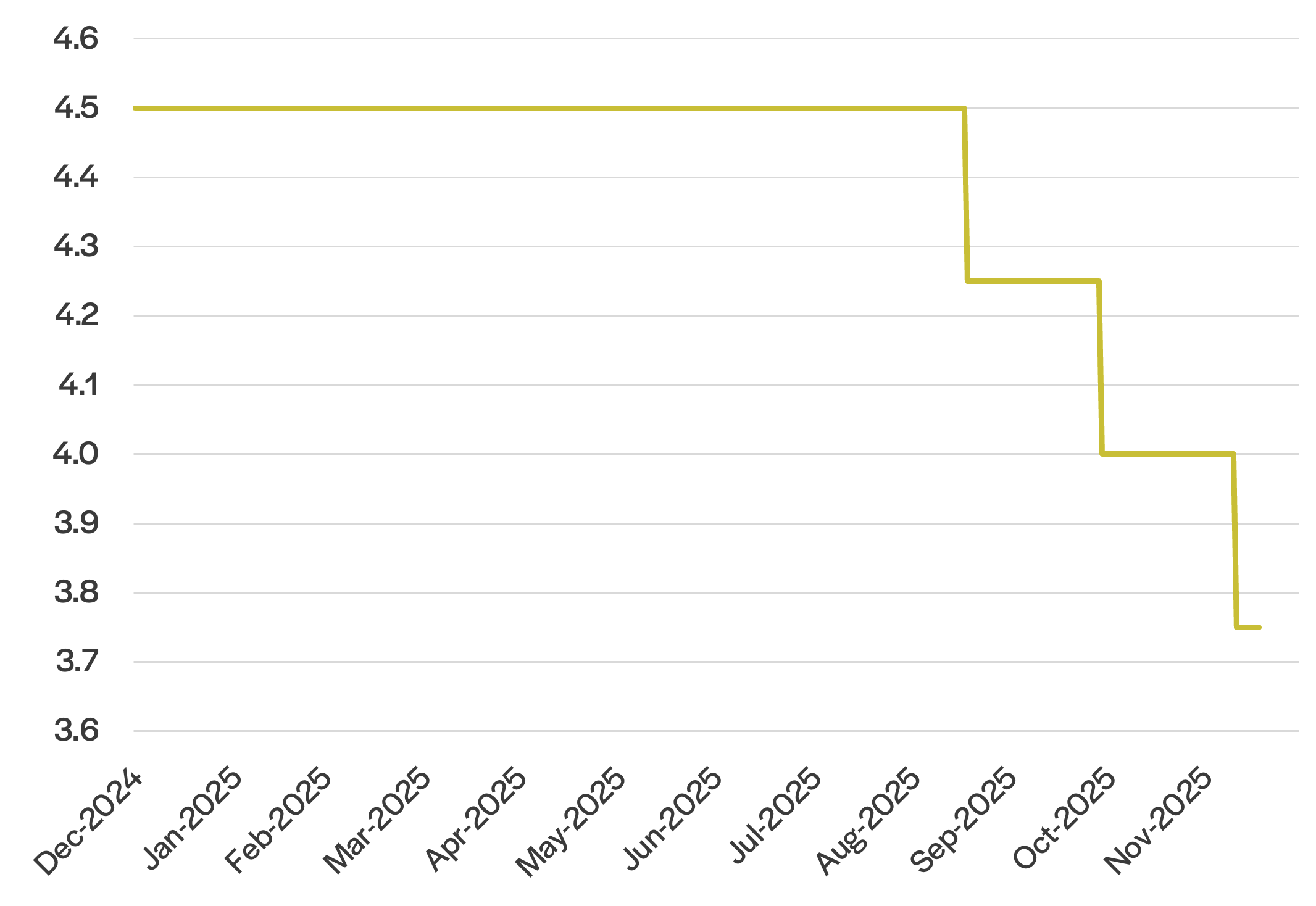
Source: Bloomberg
Current Valuations
Many companies investing heavily in artificial intelligence infrastructure are large publicly traded technology firms, including Nvidia, Google, Microsoft, Amazon, Apple, Meta Platforms, and Tesla. While market participants have shown increased interest in these companies in connection with AI-related developments, these firms generally operate diversified business models beyond AI-specific initiatives and generate significant cash flow from multiple sources.
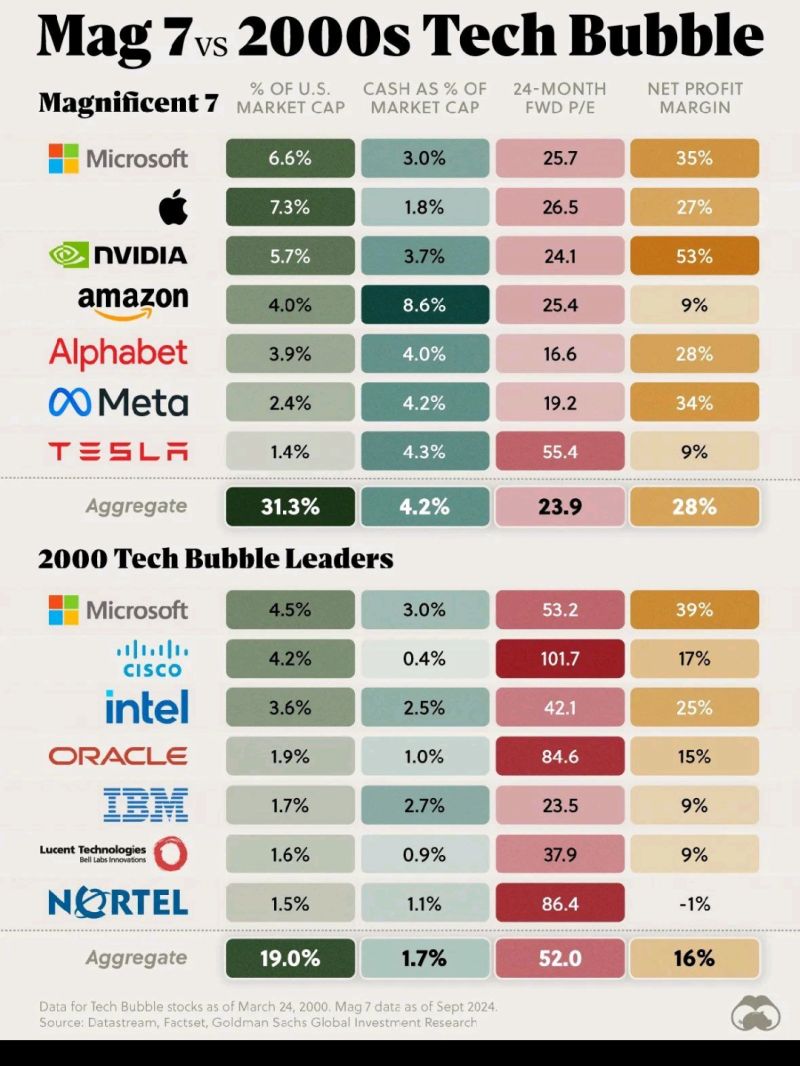
In 1999, the seven largest companies carried an average valuation of 67x forward earnings, and in 2025, the seven largest companies (the Magnificent 7) trade at a valuation of just under 30x forward earnings less than half as expensive as tech stocks in 1999, and the 2025 PE includes Tesla, which skews the average with a valuation of 200x.
Source: Visual Capitalist
There are other AI companies that carry a much richer valuation than the seven tech stocks mentioned above. Open AI, the privately owned provider of ChatGPT and an important part of the bubble story, is valued at $500 billion despite just $15 billion in revenue and no earnings. Anthropic, another private company that has developed a large language model capable of processing and generating natural language, has $7 billion in revenue and is valued at $350 billion. Palantir is a public company with commercial applications, but it is primarily known as a government vendor, providing AI-powered software that helps governments and intelligence agencies organize and analyze large, complex data sets. Palantir has revenues of $4 billion and has a market cap of $447 billion. All three companies are experiencing rapid revenue growth, and that growth must continue for their current valuations to be justified. If it slows, we may find that there was not a broad AI bubble but rather bubbles in the stock prices of certain individual companies.
Debt
Debt and financing structures are an additional area of focus when evaluating periods of rapid technological investment. Historically, easy access to credit has been a common feature of speculative cycles, and similar dynamics have emerged among some AI-related companies. In certain cases, companies within the AI ecosystem both sell services to and invest in one another, creating interconnected financial relationships that may amplify risk if growth expectations are not met. For example, OpenAI has reported revenue growth but has entered into long-term infrastructure agreements to secure computing capacity. One such agreement involves Oracle, which would require substantial capital investment to support expanded data-center capacity. These arrangements illustrate how future growth assumptions, capital expenditures, and financing needs can influence company valuations and investor sentiment over time. Market reactions to announced agreements may reflect changing expectations as new information becomes available as has been seen in the fluctuating stock prices of some of the publicly traded AI companies.
Conclusion
We are not yet ready to call artificial intelligence a bubble, as the level of speculative enthusiasm does not appear to be evenly distributed across the industry. Many of the major players involved are well-established companies with diversified businesses and strong cash flow, rather than firms whose success depends entirely on a single technological outcome. That said, we believe discernment matters. Periods of rapid innovation often attract a wide range of participants, and not all companies pursuing similar opportunities will ultimately prove durable. In our view, selectivity remains important when evaluating which businesses are best positioned to navigate an increasingly competitive environment. While we do not believe the broader AI theme necessarily represents a bubble that will drag down the entire market, the competitive nature of the space suggests that outcomes will likely vary significantly across companies over time. In the meantime, recent pullbacks in parts of the technology sector can serve as a healthy reminder of the value of maintaining a balanced, diversified portfolio focused on long-term objectives rather than short-term speculation.
Final Thoughts: How Transformative is AI?
The extent to which AI will ultimately be transformative remains unclear, and that uncertainty is one reason the bubble debate is so prevalent. I find the topic particularly important because a common narrative around AI is that it can replace people in nearly every type of business—and even substitute for human relationships. That narrative is often reinforced by AI companies seeking to justify today’s extraordinary levels of investment.
I worry about the societal consequences of moving too quickly to replace human beings without fully considering the implications. Such a shift could have meaningful societal consequences if young people who seek productive, meaningful work encounter fewer opportunities over time. While those outcomes may not be imminent, they are serious considerations.
At the same time, human connection is essential to our ability to survive and thrive. That belief underpins why we require our employees to work in the office and why we emphasize personalized service with our clients. We believe this human-first approach will continue to be a differentiator, reflecting our conviction that human connection matters deeply in an increasingly digital world.
Disclosures: This commentary is provided for informational and educational purposes only and does not constitute investment advice, a recommendation, or an offer to buy or sell any security or adopt any investment strategy. The views expressed are those of the author as of the date of publication and are subject to change without notice based on market conditions, economic developments, or other factors.
Any references to specific companies, securities, asset classes, or investment themes are for illustrative purposes only and should not be interpreted as a recommendation or indication of future performance. Not all investments discussed are held in client portfolios, and holdings may change at any time. There is no guarantee that any investment strategy discussed will be successful. Market commentary and historical examples are included solely to provide context and perspective. Past performance is not indicative of future results. Historical market events, trends, or valuation levels may not repeat and should not be relied upon as predictors of future market behavior. Forward-looking statements are inherently uncertain and involve risks, assumptions, and unknown factors that could cause actual outcomes to differ materially. References to market indices, including but not limited to the S&P 500 Index and NASDAQ Composite Index, are provided for comparative purposes only. Indices are unmanaged, do not reflect the deduction of fees or expenses, and cannot be invested in directly. Statements regarding monetary policy, interest rates, economic conditions, or Federal Reserve actions reflect current expectations and interpretations at the time of writing. Actual policy decisions and economic outcomes may differ materially and may impact markets in unpredictable ways. Discussion of artificial intelligence, emerging technologies, or related business models reflects general observations and does not imply that such technologies will result in favorable investment outcomes. Investments associated with new or rapidly evolving technologies may be subject to heightened volatility, valuation risk, regulatory uncertainty, and competitive pressures. Diversification and asset allocation strategies do not ensure a profit or protect against loss in declining markets. All investing involves risk, including the potential loss of principal. Howe & Rusling, Inc. is an SEC-registered investment adviser. Registration does not imply a certain level of skill or training.