
Automatic Saving
Essentially, automatic saving involves setting up recurring transfers from your primary bank account into a dedicated savings or investment account. This can be a standard savings account for short-term goals like an emergency fund or a down payment, an IRA for a long-term goal of retirement savings, or a brokerage account for any number of goals. The main point is establishing a consistent schedule for the transfers which removes the need for regular input and promotes a habit of disciplined saving.
This “set it and forget it” approach frees you from having to constantly remind yourself to save. When the money is transferred before you have a chance to spend it, “paying yourself first,” you are dedicating some of your income to your future. By consistently accumulating funds this way, you can help to provide a safety net for unexpected expenses like car repairs, medical bills, or possibly unemployment. After an emergency fund is covered, you can start to work on building your savings for other goals.
Automatic Investing
Going a step further, automatic investing combines the consistency of automated transfers with a strategy known as dollar-cost averaging. Dollar-cost averaging is the practice of investing incrementally, at regular intervals, regardless of an asset’s price or the market conditions. The benefits to dollar-cost averaging include reducing market timing risk and avoiding emotional decision-making. It can potentially lead to lower average cost per share over time. Here is an example:
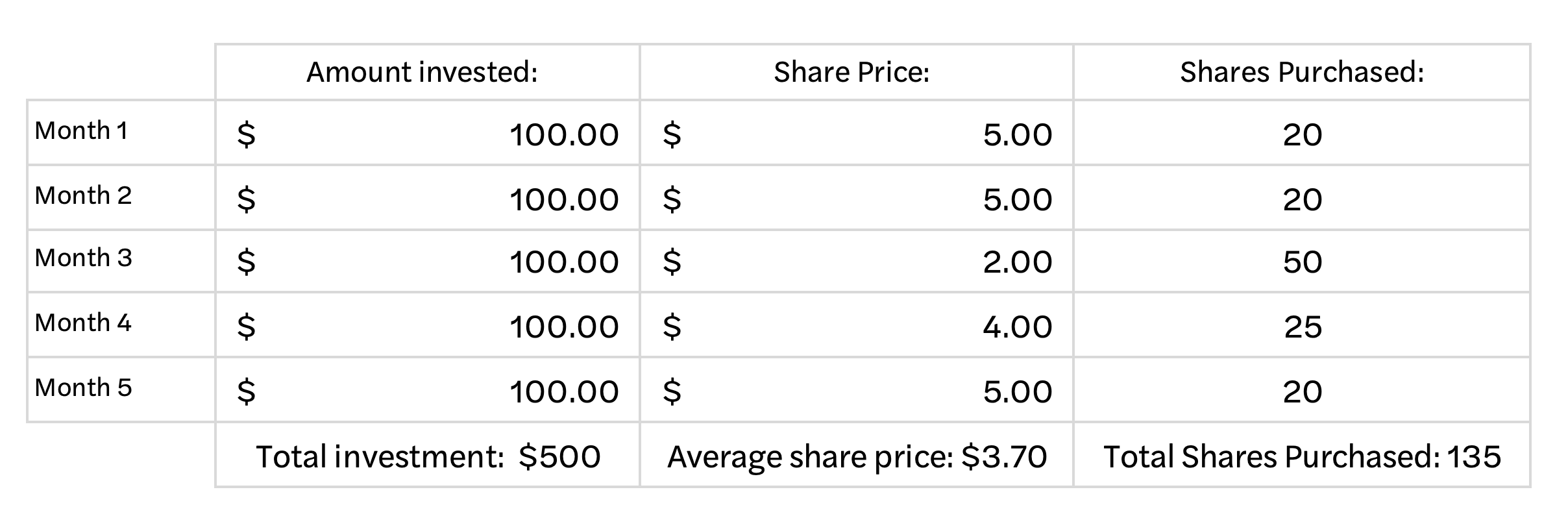
Using this method means that when the asset prices are high, your investment buys fewer shares, but when the price is lower, the same investment can buy more shares. With this approach you become a disciplined investor by default by making the decision to invest once and letting the system function automatically after that. The result is a focus on consistent, long-term results instead of trying to time the market, which can be notoriously difficult.
Options to Consider
There are many options in the realm of automatic savings and investing to fit the varied circumstances, goals and risk tolerances of investors. When establishing your strategy there are several things to consider.
Type of Account
- Standard Savings Account: These can be useful for emergency funds and short-term goals. They are liquid and accessible.
- Individual Retirement Accounts (IRAs): Traditional IRAs (pre-tax contributions with tax-deferred growth) and Roth IRAs (after-tax contributions with tax-free growth) are designed for retirement savings.
- Brokerage Accounts: Offer more flexibility and investment options. They are appropriate for a wide range of goals.
A Few of the Investment Options
- Exchange-Traded Funds (ETFs): Offer diversification by tracking specific indexes, sectors, or asset classes. They are traded like stocks throughout the day and often have lower expense ratios than actively managed mutual funds.
- Mutual Funds: A pool of investments managed by a professional fund manager that offers diversification and professional management with a fee that is usually higher than ETFs or index funds.
- Index Funds: A mutual fund or ETF designed to match the performance of a specific market index, like the S&P 500. Their diversification usually comes with a lower fee than traditional mutual funds or ETFs.
Maintain Your Plan
While automation helps streamline the process, you cannot truly “set it and forget it.” You must review your plan and adjust as needed based on your situation as your life and goals change.
- Monitor Your Progress: Check in on your account balances and portfolio performance to make sure you’re on track.
- Review Your Goals and Circumstances: Your ability to save and invest are impacted as your life changes – with a new job, a marriage, a new family member, or unforeseen expenses. Reexamine your goals periodically and make adjustments if necessary.
- Adjust Contributions: When your income increases, it’s wise to consider increasing the amount you save. On the other hand, if you have a hardship, you will want to think about temporarily reducing your contributions. If you can avoid it, it’s best to avoid stopping them entirely.
Long-term Impact
Your best friend and worst enemy in an automatic plan are the same: time. By waiting for a particular event or the accumulation of a particular amount of capital time works against your long-term benefit. However, beginning your automatic plan as soon as you can time works for you. You can always make adjustments as time goes by.
To see the real benefit of automatic savings and investing, you have to look at the long-term results. Making consistent contributions, coupled with the power of compound interest, may produce significant wealth accumulation over time. Eliminating the emotional element of the process can help avoid costly market volatility related mistakes.
This automated strategy can be helpful and powerful if used appropriately. It’s important to remember that you need to define and revisit your goals and establish a realistic contribution amount while developing an investment plan that considers your risk tolerance and asset allocation. Talking with a financial advisor may be helpful to ensure that your plan meets your unique situation. We at Howe & Rusling are happy to answer any questions you may have.
Disclosures: Howe & Rusling, Inc. (“H&R”) is an investment adviser registered with the U.S. Securities and Exchange Commission (“SEC”). Registration as an investment adviser does not imply a certain level of skill or training. This material is provided for informational and educational purposes only and is not intended as personalized investment advice, recommendation, or an offer to buy or sell any security. The information contained herein reflects the opinions of H&R as of the date of writing and is subject to change without notice. Any strategies discussed may not be appropriate for all investors. Investing involves risk, including the possible loss of principal. There is no assurance that any investment strategy, including automatic savings or dollar-cost averaging, will be successful or achieve any particular level of results. Strategies that automate contributions may encourage discipline, but they do not eliminate the risks of investing or guarantee a profit. Past performance is not indicative of future results. Dollar-cost averaging is a long-term investment strategy that involves making regular investments over time regardless of market conditions. While this approach may reduce the risk of investing a large amount in a single investment at the wrong time, it does not guarantee profit or protect against loss in declining markets. Any examples or illustrations provided (such as dollar-cost averaging tables) are hypothetical in nature and are for illustrative purposes only. They do not represent actual results of any client portfolio or specific investment product. Actual results may differ substantially and no representation is being made that any investor will achieve similar results. Certain information has been obtained from third-party sources believed to be reliable; however, H&R has not independently verified this information and makes no representation as to its accuracy or completeness. This material is not intended to provide, and should not be relied upon for, legal, tax, or accounting advice. Clients should consult with their own legal, tax, or accounting advisors regarding their personal circumstances.