In this blog post, we will share some brief introductory information on this exciting, emerging field.
What is quantum computing?
Quantum computing refers to a developing field of computer science that relies on quantum mechanics.
Quantum computers are computers that consist of quantum bits, or “qubits,” that play a similar role to the bits in today’s digital computers. The laws of quantum mechanics allow qubits to encode exponentially more information than bits. By manipulating information stored in these qubits, scientists can quickly produce high-quality solutions to difficult problems. This means quantum computing may revolutionize our ability to solve problems that are hard to address with even the largest supercomputers. Scientists have demonstrated these quantum speedups in several applications…The quantum computers available today are small, noisy prototypes, but the field is progressing rapidly. Quantum computers may soon become a critical part of the computing landscape… – US Department of Energy (DOE Explains…Quantum Computing | Department of Energy)
What are the differences between quantum computing and classical computing?
The charts displayed below highlight some of the key differences between quantum and classical computing. We believe the most notable differences are as such: classical computing bits are independent and can represent either 0 or 1; classical computing processes instructions one at a time. In contrast, quantum computing uses qubits, which can represent 0 and 1 at the same time. Quantum computing can process tasks simultaneously.

Quantum Computing Vs. Classical Computing In One Graphic – CB Insights Research

Quantum Computing Introduction Easy Clear Explanation of QC Basics for Beginners
What are the benefits of quantum computing?
As you may have surmised based on the information provided above, quantum computing is significantly more powerful than classical computing. Quantum computing may have a transformative impact in many disciplines. Some of the most commonly cited future use cases include: cryptography (encryption, security), optimization (such as determining the most efficient delivery run for an Amazon truck with 100 planned stops), simulation (modeling atomic level interactions), and machine learning (extending AI capabilities).
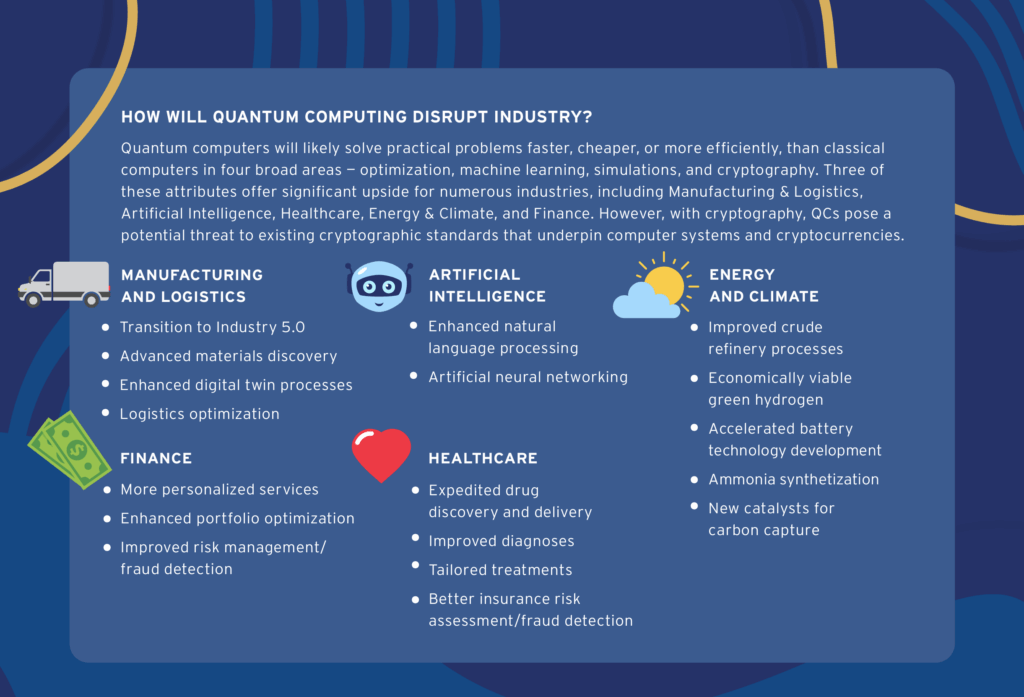
QUANTUM COMPUTING:Moving Quickly From Theory to Reality
This all sounds great, but what are the drawbacks with quantum computing?
Right now, quantum computing remains very much in an experimental phase. There are issues that must be addressed before wider use might be possible. Current quantum computing suffers from unacceptably high error rates. Error rates are driven by worsening qubit condition due to environmental factors (decoherence), operations (logic gate errors), and qubit preparation and measurement errors. Error rates for quantum computing are about 1 in 1000* vs. 1 in 1 billion for classical computers. For widespread, practical quantum computing use to occur, the error rate issue must be resolved. We also note that quantum computing is expensive and must be conducted in perfect conditions, which is not practical for pervasive use either.
*1 in 1000 error rate is the new breakthrough achieved by Google’s Willow chip. News broke on this in December 2024, which sparked a rally for investments in the quantum theme. Previously error rates were closer to a 1 in 100+ range.
Who are the current customers?
Most current quantum business is research-oriented. The customer base primarily consists of academic institutions, research organizations, and other tech companies. Some Fortune 500 companies have used quantum services, but only in experimental endeavors to date. Services are usually delivered via the cloud, either from one of the pure plays directly, or from one of the big tech clouds (such as Microsoft’s Azure, Amazon Web Services, or Google), which often operate hardware from one of the pure plays.
Will quantum computing replace classical computing?
Based on currently available information and expectations, probably not. If quantum develops, it may be especially useful for certain specific tasks. Classical computers may continue to handle the non-specific, majority of computing workloads. So, in short, quantum is expected to complement classical computing, not replace it. This is particularly likely at the early stages of broader quantum use (should that come to fruition).
What are we looking for? What could trigger a ChatGPT-like moment for the markets?
Judging what will constitute an “a-ha” moment for markets is notoriously difficult. That said, given the potentially transformative and large impact from a technological breakthrough like quantum computing, we are intently monitoring the space. First and foremost, we are watching progress on error rates. The more reliable quantum computing becomes, the more practical it may be, which would likely increase investor excitement. We caught a glimpse of this in December 2024 with the Google Willow news. We note that some optimism has subsided in the quantum theme since then as investors have had to reckon with scaled, practical use still likely being a long way off. Second, we are monitoring the various timelines thrown out by key industry leaders (either those primarily involved in quantum or in classical computing). At present, the optimistic timeline of practical use is about five years away. Most timelines provided are usually 10+ years out. Third, we are watching progress on how scalable quantum is. And fourth, we are monitoring for progress toward practical applications.
Developments across any of the monitoring points listed above could coincide with a major shift in how the market views quantum computing.
Who are the quantum market participants?
The following market map provides a quick (but not exhaustive) illustration of some of the players in quantum computing. The participants are a mix of established companies and pure plays/start-ups. Noteworthy established company players (i.e. firms with established businesses outside quantum): Alphabet (Google), Microsoft, Honeywell (Quantinuum), Amazon, NVIDIA, Intel, IBM. Noteworthy pure plays: IonQ, D-Wave Quantum, Rigetti Computing, Arqit Quantum, Quantum Computing Inc.

Quantum Computing Market Map and Data 2022
Concluding thoughts
Quantum computing has the potential to be a profound technological breakthrough on par with the introduction of computers, cell phones, the internet, social media, and AI. While practical use is still a relatively distant possibility, the gravity of ramifications from quantum computing makes this a critical field to monitor as it continues to develop. We are excited about the hypothetical quantum future, with the many benefits it may provide to society and the potential investment opportunities that may arise.
Appendix
If you would like to dive deeper into quantum computing, check out the links below.
QUANTUM COMPUTING:Moving Quickly From Theory to Reality
A primer on the quantum landscape | S&P Global
What is Quantum Computing? – Quantum Computing Explained – AWS
What Is Quantum Computing? | IBM
DOE Explains…Quantum Computing | Department of Energy
What are some key terms to understand how quantum computing works?
Superposition – Quantum property allowing multiple base states at the same time (in QC – 0 and 1 at the same time).
Entanglement – When particles are created, interact or are close to others, the quantum state of each particle is determined by the system. Changing the state of one participle immediately affects the other. In QC, this allows for the vast improvement in processing speed. If there was no entanglement, processing would resemble a classical computer.
Coherence – When qubit states are kept free from environmental “noise” or influence. Greater coherence increases the amount of quantum compute processing that can occur. Environmental influence is a key driver of the high error rates seen in current quantum computing.
Fidelity – Quantification of the reliability of quantum operations. Issues arise from gate errors (operations) + state preparation & measurement errors.
What are the different approaches to quantum computing?
There are three main approaches in quantum computing today: superconducting, ion trap, and quantum annealing.
Superconducting – Qubit creation via circuits. Qubit is affected by microwave pulses or lasers. Conducted at near zero temperatures.
Pro – Fast gate speeds. Scalable.
Con – Need to operate at near zero temperatures. Very susceptible to environmental influence. Shorter coherence (time to conduct operations).
Companies using this approach – GOOG, IBM, MSFT, Rigetti
Ion trap – Qubit creation from ions trapped in electromagnetic fields. Affect qubits with lasers or microwave pulses.
Pro – Longer coherence (time to conduct operations). Operate at room temperature. Stability. Accuracy.
Con – Slow gate speeds. Less scalable than other methods.
Companies using this approach – IonQ, Quantinuum (Honeywell)
Quantum annealing – Special, limited in scope type of quantum computing for optimization tasks. Finds the lowest energy state which links up to the optimal solution.
Pro – Great for optimization problems. Less prone to noise.
Con – Limited end use cases (narrow scope).
Companies using this approach – D-Wave
In our view, with QC being a developing field, it seems premature to try to select which technical approach will win out. Superconducting appears to have the highest potential but also has the highest hurdle with issues that need to be solved. If the issues are solved, superconducting will probably be the winner. But perhaps superconducting will not be achievable, and less robust methods like ion trap or annealing will be the long-term winners. Hard to say at this early stage.
Disclosures: This material is provided for informational and educational purposes only. It is not intended to be, and should not be construed as, investment, tax, legal, or financial advice. The views and opinions expressed do not necessarily reflect those of Howe & Rusling, Inc., and are subject to change at any time based on market or other conditions. This communication is not intended as a recommendation, offer, or solicitation to buy or sell any security, investment product, or strategy. Any mention of specific securities, companies, or investment themes is purely illustrative and should not be interpreted as a recommendation or endorsement. Certain information contained in this material may constitute forward-looking statements or projections. These statements involve assumptions, risks, and uncertainties, and actual outcomes may differ materially. No representation or warranty is made as to the future performance or viability of any technology, trend, or company mentioned. The discussion of quantum computing, artificial intelligence, and related technologies includes speculative information about emerging fields. These areas are subject to rapid change, and there is no guarantee that the anticipated developments or outcomes will occur. Any investment decisions related to these themes should be made with full understanding of the risks and in consultation with a qualified investment advisor. This material may reference or cite content, graphics, or research from third-party sources including but not limited to CB Insights, the U.S. Department of Energy, AWS, IBM, and S&P Global. Howe & Rusling, Inc. makes no representation as to the accuracy or completeness of such third-party information and does not endorse or assume responsibility for any content provided by external sites or organizations. Howe & Rusling, Inc. is not affiliated with, nor endorsed by, any of the companies or governmental agencies mentioned in this piece. Howe & Rusling, Inc. is an investment adviser registered with the U.S. Securities and Exchange Commission (SEC). Registration as an investment adviser does not imply any specific level of skill or training.